

小社が立地する熊本にある熊本大学とパートナーシップ協定を結んでいるタイの大学研究者によるライフサイエンス分野の連載(4 回)をお届けします。
Coordinated Glucose–Lipid Metabolic Rewiring in Cancer Progression

Kulthida Vaeteewoottacharn
Department of Biochemistry and Center for Translational Medicine, Faculty of Medicine,
Khon Kaen University
Division of Hematopoiesis, Joint Research Center for Human Retrovirus Infection and Graduate School of Medical Sciences, Kumamoto University

Saowaluk Saisomboon
Department of Biochemistry and Center for Translational Medicine, Faculty of Medicine,
Khon Kaen University
Division of Hematopoiesis, Joint Research Center for Human Retrovirus Infection and Graduate School of Medical Sciences, Kumamoto University

Natnicha Paungpan
Department of Biochemistry and Center for Translational Medicine, Faculty of Medicine,
Khon Kaen University
Division of Hematopoiesis, Joint Research Center for Human Retrovirus Infection and Graduate School of Medical Sciences, Kumamoto University
Abstract
Metabolic reprogramming is a hallmark of cancer, enabling cancer cells to sustain biosynthetic and energetic demands and adapt to microenvironmental stresses. Among these alterations, enhanced glucose utilization and dysregulated lipid metabolism are key metabolic features supporting cancer growth and aggressiveness. Increasing evidence suggests that glucose and lipid metabolism are not independent processes but are tightly interconnected, forming a coordinated metabolic network that fuels biosynthesis and promotes metastatic potential. This review summarizes the molecular mechanisms underlying glucose–lipid metabolic integration and discusses its contribution to cancer progression, with particular emphasis on cholangiocarcinoma (CCA), a highly lethal liver cancer. We further highlight emerging therapeutic strategies targeting this metabolic axis, including the potential repurposing of glucose-lowering and lipid-modulating agents. Understanding this coordinated metabolic rewiring may facilitate the development of multi-target metabolic interventions for improved cancer treatment.
1. Metabolic Reprogramming in Cancer Cells
Metabolic reprogramming is widely recognized as a hallmark of cancer and a critical driver of cancer progression, therapeutic resistance, and metastatic dissemination 1). During cancer development, cancer cells undergo selective metabolic adaptations that optimize energy production while ensuring a continuous supply of biosynthetic precursors required for uncontrolled proliferation 2,3). These adaptations enable cancer cells to survive under fluctuating nutrient availability, hypoxia, and oxidative stress within the cancer microenvironment.
The earliest recognized metabolic alteration in cancer is enhanced glucose uptake and preferential utilization of aerobic glycolysis, known as the Warburg effect 4). Although glycolysis generates less ATP per glucose molecule than oxidative phosphorylation, its high metabolic flux supplies intermediates for nucleotide, amino acid, and lipid biosynthesis 4-6). Thus, glucose metabolism functions not merely as an energy source but as a central hub for biomass accumulation.
In parallel, lipid metabolism has emerged as another crucial component of cancer metabolic adaptation. Together, glucose and lipid metabolic rewiring form an integrated network that supports cancer survival, growth, and invasion. Given the central roles in cancer cells, this metabolic coordination confers adaptive advantages and may represent a clinically exploitable vulnerability 7,8).
2. Glucose Metabolism in Cancer: The Warburg Effect and Metabolic Flux
The Warburg effect describes the preferential conversion of glucose to lactate in cancer cells, even under normoxic conditions 4). Although less efficient in ATP generation compared to oxidative phosphorylation, high glycolytic flux provides abundant metabolic intermediates, such as pyruvate and citrate, that feed biosynthetic pathways, including lipid synthesis 9,10). Key glycolytic enzymes, including glucose transporter (GLUT), hexokinase (HK), phosphofructokinase (PFK), pyruvate kinase (PK), lactate dehydrogenase (LDH), and monocarboxylate transporters (MCTs), are frequently upregulated in cancer cells (Figure 1) 7).
Oncogenic signaling pathways and hypoxia-inducible factors dynamically regulate these glycolytic components, ensuring sustained glucose flux to support anabolic demands. The metabolic balance between glycolysis and oxidative phosphorylation is context-dependent and influenced by environmental constraints 7,11). Rather than a complete abandonment of mitochondrial metabolism, many cancers exhibit metabolic flexibility, enabling adaptation to nutrient availability.
In cholangiocarcinoma (CCA), an aggressive cancer, aberrant glucose metabolism is well documented. Our group, led by Professor Sopit Wongkham, has demonstrated consistent upregulation of key glycolytic regulators in CCA tissues. Aberrant expression of GLUT1 and HKII promotes enhanced glucose uptake and intracellular trapping of glucose 12,13), while increased PKM2 and LDHA facilitate lactate production 14,15). Furthermore, upregulation of MCT1/4 supports lactate export, thereby preventing intracellular acidification and promoting cancer cell survival 16). The resulting accumulation of lactate acidifies the cancer microenvironment, promotes epithelial–mesenchymal transition (EMT), and enhances cell motility, thereby facilitating metastatic dissemination 17).
Epidemiological evidence further supports the role of glucose in CCA progression. Hyperglycemia and diabetes mellitus are associated with increased risk and poorer prognosis in CCA 18,19). High-glucose conditions enhance oncogenic signaling, including signal transducer and activator of transcription 3 (STAT3) activation, and increase flux through the hexosamine biosynthetic pathway, leading to increased glycosylation and enhanced cancer aggressiveness 20,21).
3. Lipid Metabolism as a Driver of Cancer
Beyond glucose metabolism, lipid metabolic reprogramming plays a crucial role in cancer progression. Lipids serve structural, energetic, and signaling functions, contributing to membrane synthesis, second messenger production, and energy storage 7). Emerging evidence indicates that lipid metabolic rewiring is not merely supportive but actively drives cancer development and progression. In 2020, the International Agency for Research on Cancer (IARC) reported a strong association between obesity and the risk of several cancers, including post-menopausal breast, colorectal, esophageal, endometrial, kidney, gallbladder, ovarian, pancreatic, liver, stomach, and thyroid cancers 22).
Experimental studies have demonstrated that dietary manipulation can influence cancer lipid metabolism and growth 5). Caloric restriction suppresses cancer growth, whereas maintenance of specific fatty acid compositions in the lipid-depletion condition suggests a requirement for both exogenous lipid uptake and de novo lipogenesis.
The importance of lipogenesis in cancer was long recognized 23,24). In 1979, Szutowicz A demonstrated that ATP citrate lyase (ACLY) activity is increased more than 150 times in breast cancer tissues compared to normal counterparts 23). Moreover, upregulations of key proteins in de novo lipogenesis, e.g., fatty acid synthase (FASN), acetyl-CoA carboxylase (ACC1/ACC2), and sterol regulatory element-binding protein (SREBP), are frequently observed in cancers 7,24). These proteins enable cells to synthesize large amounts of fatty acids and other lipids, which are necessary for membrane biogenesis, energy storage, and signaling (Figure 1) 7). In CCA context, elevated expression of ACC1, FASN, and ACLY has been observed in cancer tissues, with high protein levels correlating with poor patient prognosis 25-27). These findings underscore the importance of lipogenesis in CCA progression and highlight lipid metabolic enzymes as potential therapeutic targets.
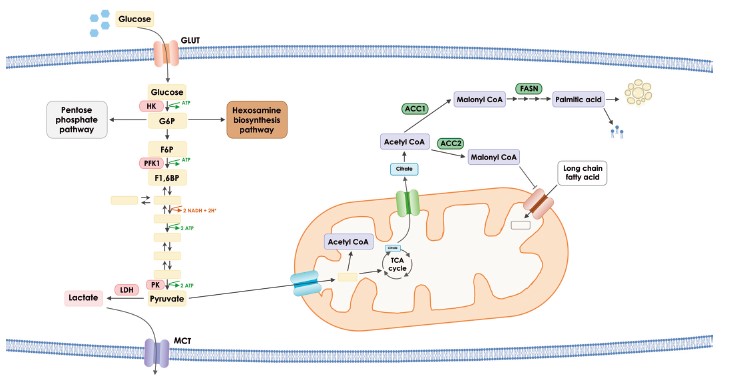
Coordinated glucose and lipid metabolic pathways in cancer cells. ACC, acetyl-CoA carboxylase; ACLY, ATP citrate lyase; CPT1, carnitine palmitoyltransferase 1; F1,6BP, fructose 1,6-bisphosphate; F6P, fructose 6-phosphate; FASN, fatty acid synthase; G6P, glucose 6-phosphate; GLUT, glucose transporter; HK, hexokinase; LDH, lactate dehydrogenase; MCT, monocarboxylate transporter; PK, pyruvate kinase; PPP, pentose phosphate pathway; TCA cycle, tricarboxylic acid cycle.
4. Glucose–Lipid Coupling: Effects on Cancer Progression
Glucose and lipid metabolism are metabolically interconnected. As early as 1953, studies demonstrated that glucose-derived carbon was converted into lipids in cancer tissues 28). Glycolysis-derived pyruvate enters the mitochondria and is converted into citrate, which is subsequently exported to the cytosol. ACLY then cleaves citrate into acetyl-CoA, providing the precursor for fatty acid and cholesterol synthesis. Concurrently, the pentose phosphate pathway generates NADPH, supplying reducing equivalents required for lipogenesis (Figure 1). This coordinated network enables cancer cells to efficiently allocate carbon and redox resources toward biomass expansion and stress adaptation. Distinct lipidomic profiles have been identified across cancer types 29), suggesting context-specific lipid dependencies within particular cancer microenvironments.
Our group provided mechanistic insight into this metabolic coupling in CCA 25). High-glucose conditions increased intracellular malonyl-CoA production and lipid droplet accumulation. These effects were potentiated by palmitate supplementation and attenuated by genetic editing of ACC1. ACC1-deficient CCA cells acquire reduced ATP levels but activated AMP-activated protein kinase (AMPK), indicating energetic stress. Functionally, ACC1-deficient CCA cells exhibited impaired proliferation and reduced migratory capacity 25,30). These findings demonstrate that de novo lipogenesis is vital to maintaining cellular energy homeostasis and metastatic potential.
5. Therapeutic Implications: Multi-target Metabolic Intervention
Given the central roles of glucose and lipid metabolism in cancer progression, targeting these pathways presents a promising therapeutic strategy. Metabolic interventions may disrupt both energy production and biosynthetic capacity. Metabolic modulators such as metformin and anti-obesity agents have emerged as potential adjunct therapies that target cancer metabolic dependencies for the conventional as well as personalized immunotherapy 31,32).
Metformin, a widely used glucose-lowering agent, activates AMPK and suppresses anabolic signaling pathways, including mammalian target of rapamycin (mTOR) and lipogenesis 31,33). Anti-obesity medications and lipid-lowering agents interfere with lipid biosynthesis and cholesterol metabolism 22). In preclinical models of CCA, targeting glucose and lipid metabolism suppresses cancer growth and metastatic behavior 25,33,34).
Importantly, single-pathway inhibition may be insufficient due to metabolic compensation. Cancer cells exhibit remarkable metabolic plasticity, enabling adaptive rewiring following targeted inhibition. Therefore, multi-target metabolic strategies that simultaneously disrupt glycolytic flux and lipogenesis may offer superior therapeutic efficacy. Incorporating metabolic biomarkers into diagnostic panels may further enable the identification of patients most likely to benefit from metabolic interventions.
6. Conclusion and Future Perspectives
Cancer metabolic rewiring extends beyond isolated alterations in glycolysis or lipogenesis; rather, it represents an integrated and adaptive metabolic circuitry that sustains cancer growth and progression. Coordinated glucose–lipid coupling provides cancer cells with metabolic flexibility, biosynthetic capacity, and resilience under therapeutic stress. Recognizing this interdependence reframes cancer metabolism from a descriptive hallmark to a strategically actionable vulnerability.
Future research should focus on identifying context-specific metabolic dependencies and on defining biomarkers that stratify cancers by metabolic phenotype. Integrative approaches combining metabolic flux analysis, lipidomics, proteomics, and functional modeling will be essential to uncover compensatory mechanisms that arise following metabolic inhibition. Importantly, rational combination strategies that concurrently disrupt glucose and lipid metabolic pathways, potentially in combination with immunotherapy or precision-targeted treatments, may overcome metabolic plasticity and improve therapeutic durability. A coordinated metabolic targeting strategy may therefore represent a promising direction for next-generation cancer therapy.
Acknowledgements
This work was supported by research grants from Khon Kaen University, and IRN-Cancer metabolism and drug target (CMD). NP was supported by a Royal Golden Jubilee Ph.D. (RGJ) grant funded by the National Research Council of Thailand (NRCT5-RGJ63003-051).
Due to the space limitation, we sincerely apologize to colleagues whose relevant work could not be cited.

Members of Vaeteewoottacharn’s Laboratory in the Department of Biochemistry.
[Contact]
Corresponding author:
Kulthida Vaeteewoottacharn(Ph.D., M.D.)
ORCID ID: 0000-0001-6557-9680
Department of Biochemistry and Center for Translational Medicine, Faculty of Medicine, Khon Kaen University,
Khon Kaen 40002, Thailand
Division of Hematopoiesis, Joint Research Center for Human Retrovirus Infection and Graduate School of Medical Sciences, Kumamoto University,
Kumamoto, 860-0811 Japan
Current position: Ph. D. candidate (Khon Kaen University, Thailand, Double Ph. D. program)
Current interests: cancer and cancer microenvironment interaction, extracellular vesicles
Current positions:
Acting director of the Northeast Laboratory Animal Center (NELAC), Khon Kaen University, Thailand
Visiting Professor in Graduate School of Medical Science, Kumamoto University, Kumamoto, Japan
Current interests: cancer cell biology and cancer metabolism, cancer and cancer microenvironment interaction, cancer patient-derived model for biological and translational study
Second author:
Saowaluk Saisomboon (Ph.D.)
ORCID ID: 0009-0006-9019-6888
Department of Biochemistry and Center for Translational Medicine, Faculty of Medicine, Khon Kaen University,
Khon Kaen 40002, Thailand
Division of Hematopoiesis, Joint Research Center for Human Retrovirus Infection and Graduate School of Medical Sciences, Kumamoto University,
Kumamoto, 860-0811 Japan
Current position: Lecturer
Current interests: cancer cell biology and cancer metabolism
Third author:
Natnicha Paungpan (Ph.D.) (Kumamoto University, Japan)
ORCID ID: 0000-0002-1763-5446
Department of Biochemistry and Center for Translational Medicine, Faculty of Medicine, Khon Kaen University,
Khon Kaen, 40002, Thailand
Division of Hematopoiesis, Joint Research Center for Human Retrovirus Infection and Graduate School of Medical Sciences, Kumamoto University,
Kumamoto, 860-0811, Japan
Current position: Ph.D. candidate (Khon Kaen University, Thailand, Double Ph.D. program)
Current interests: cancer and cancer microenvironment interaction, extracellular vesicles